
In January 2026, US Customs and Border Protection (CBP) ruled that an online platform’s AI classification tool could amount to unlicensed customs work. The ruling (HQ H350722) asks a question every importer now faces: who is allowed to decide your commodity code?
The answer differs sharply between the United States, the European Union and the United Kingdom. The US licenses the people who classify. The EU regulates how representatives act. The UK has some of the lightest entry rules, but not the lightest liability.
Our view at Tevolution is that AI can help find candidate codes and check documents, but it should stay in the background. Classification is a legal judgement. In our view it belongs to the importer, who normally bears the duty. An agent should advise on it with care, not take it over by default. Who decides, and who carries which liability, should be agreed in writing.
Evaluate, compile, submit: where AI fits
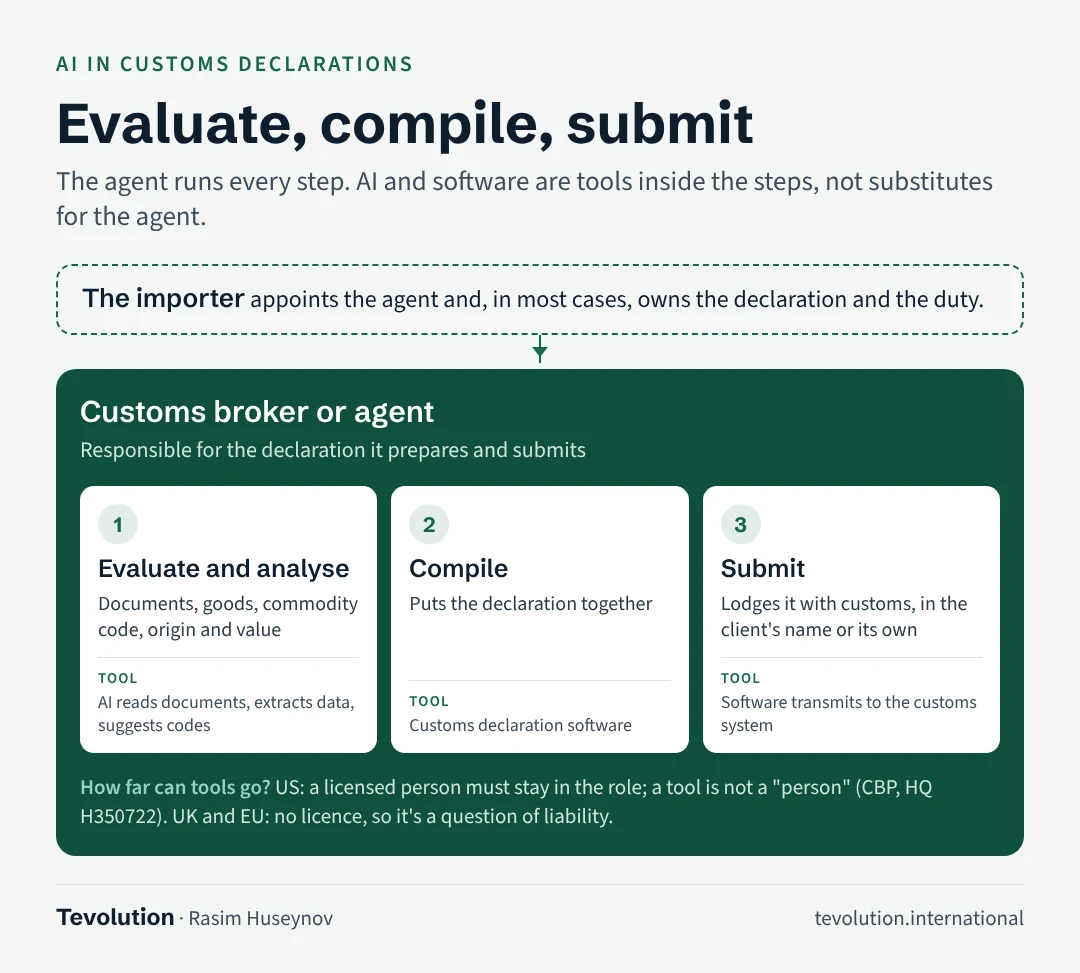
A customs agent is normally involved in every step of a declaration:
- Evaluate and analyse: check the documents and the goods, and work out the commodity code, origin and value.
- Compile: put the declaration together, usually in customs declaration software.
- Submit: lodge the declaration with customs, in the client’s name or its own, and take responsibility for it as the agent.
AI and software are tools the agent uses inside these steps. AI can read invoices, extract data and suggest codes. Declaration software builds the declaration and sends it to customs. Agentic AI may take on more of the work in future. The real question is not whether agents use these tools, but how much of each step can be handed to them, and who stays responsible. Above it all sits the importer, who in most cases owns the declaration and the duty.
The US has now drawn a line on how far that delegation can go. The UK and EU answer the same question through liability rather than licensing.
Why classification is a judgement, not a lookup
All three systems build on the World Customs Organization’s Harmonized System and its six General Interpretative Rules. The rules work in strict order: headings are compared with headings, then subheadings with subheadings. Explanatory Notes guide the reading but are not legally binding.
UK tribunals show how much reasoning this takes:
- In HMRC v International Plywood [2023] UKUT 278 (TCC), wooden panels the importer declared as concrete shuttering (0% duty) were classified as laminboard (10% duty). The tribunal held that intended use counts only where it shows in the goods’ objective features. The demand upheld was £277,930.83.
- In Cozy Pet Ltd v HMRC [2024] UKUT 96 (TCC), the tribunal applied an EU classification regulation to cat trees by analogy. It warned that reasoning by analogy “requires great care”. Pet playpen panels, by contrast, won a 0% fencing code.
An AI tool can suggest candidate headings quickly. It cannot weigh evidence, take responsibility for the outcome, or defend the code before a tribunal.
United States: a licence for the person
In the US, only a licensed customs broker may conduct “customs business” for someone else (19 U.S.C. § 1641). An individual broker must be a US citizen, at least 21 and of good character, and must pass the broker exam with at least 75% (19 C.F.R. § 111.11). A firm needs at least one licensed partner or officer.
The licence does not move liability away from the importer. The importer of record must use “reasonable care” in classifying (19 U.S.C. § 1484) and generally stays responsible for its broker’s errors. Penalties for negligence can reach up to twice the duty lost.
CBP’s ruling HQ H350722 of 16 January 2026 applied these rules to an online platform run by a foreign, unlicensed company. CBP found that:
- connecting importers with brokers is not customs business, if the platform only passes data along
- an OCR tool that picks out entry data from shipping documents is customs business
- AI classification suggestions beyond 6 digits, for goods that will be entered, are customs business; a general tool kept apart from entry, with a meaningful disclaimer, can be allowed
- filing CBP Form 5106 (importer identity) for others needs a licence
CBP’s key sentence: “A tool does not constitute a ‘person’” under the broker regulations. Where an automated tool is used to make entry, “an individual broker or other licensed person must have a role in specifying what information” it uses. In other words, a broker may use AI at every step, but the tool cannot take over the broker’s role.
European Union: rules for the act of representing
The EU has no single customs broker licence. Under the Union Customs Code (UCC), anyone may appoint a customs representative (art. 5(6)). There is no nationality requirement, but the representative must normally be established in the EU (art. 18). Each member state may set its own conditions, so the regime differs across the Union:
- France requires registration. Since 1 January 2018, anyone offering customs representation for others must first register as a représentant en douane enregistré (RDE). Applicants must show professional competence, a clean customs and tax record, and a management system that allows controls. AEO holders qualify on their status.
- The Netherlands is known as an investor-friendly trade hub, but that does not make its customs requirements light. In our experience, getting registered there can be demanding.
A representative meeting the Authorised Economic Operator criteria (art. 39) may also act in member states other than its own.
The EU regulates how the representative acts rather than who they are:
- Direct representation: the representative acts in the client’s name and on the client’s behalf.
- Indirect representation: the representative acts in its own name, on the client’s behalf. Both the representative and the client are liable for the customs debt (art. 77(3)). Anyone who supplied information for the declaration that they knew, or ought reasonably to have known, was false is also liable.
- Empowerment: the representative must state that it acts for a client, and in which capacity. If it doesn’t, it is treated as acting in its own name (art. 19).
For certainty on classification, importers can hold a Binding Tariff Information decision. It binds customs and the holder across the EU for 3 years. Only the named holder can rely on it, as the Court of Justice held in Sony Supply Chain Solutions (C-153/10, 2011).
Enforcement is national: customs law is harmonised, but each member state decides how closely to scrutinise declarations, whether to prosecute and what penalties to apply. We have not found EU guidance specific to AI in customs declarations.
The direction of travel is clear, though. Under the customs reform agreed politically by the Parliament and Council in March 2026, “Trust and Check” traders will give customs access to their own electronic systems, and an EU Customs Data Hub is due to replace national customs IT systems (optional from 2031, mandatory from 2034, subject to the final text). Customs will see more of the data directly, which raises the stakes for whoever compiles it.
United Kingdom: light entry, real liability
The UK calls brokers “customs agents” (Taxation (Cross-border Trade) Act 2018, s. 21). There is no licence and no nationality requirement. Agents must be established in the UK, with limited exceptions such as acting for a principal who need not be established here (Customs (Import Duty) (EU Exit) Regulations 2018, reg. 80). The Act allows HMRC to require approval of agents, and that may be coming. From 22 June to 21 September 2026, HMRC consulted on mandatory registration for intermediaries who submit declarations for traders, with requirements mirroring those for tax advisers. The proposals are not yet confirmed.
Light entry does not mean light liability:
- Indirect agent: declares in its own name and is liable for import duty together with the importer.
- Direct agent: declares in the importer’s name. It becomes liable too if the appointment wasn’t disclosed to HMRC, was withdrawn, or the agent acted without authority.
HMRC’s guidance on customs debt liability supports keeping the decision with the importer. Under direct representation, the importer is “solely liable”. The agent becomes jointly liable only where the importer gave clear instructions and the agent made a “deliberate or unreasonable error”.
It also helps to separate three kinds of liability, because they work differently:
- The duty itself: owed by the importer, and also by an indirect agent, or a direct agent in the cases above. A contract between importer and agent cannot change who HMRC may pursue.
- Penalties: depend on the facts, including whether reasonable care was taken. Relying on a competent adviser may be relevant to that question, but it is not an automatic defence.
- The agent’s professional responsibility: an agent owes its client reasonable care and skill in the service it provides. The contract can define that service and allocate risk between the two of them, within what the law allows.
That is why responsibility for classification should not be assumed. If an agent agrees to take it on, the agreement should say so expressly.
Importers can secure certainty with an Advance Tariff Ruling. It is legally binding, but only the named holder can use it.
On AI, the UK’s answer is transparency rather than licensing. PAS 41201:2026, the voluntary standard for customs intermediaries published with HMRC in June 2026, says: “If you are using AI to assist with declaration completion, this should be disclosed to the principal.” HMRC also lists providers of declaration software but does not endorse them, and says it is not responsible for losses from using them.
Side by side
The three systems put the gate in different places, and the AI question changes with it.
| United States | European Union | United Kingdom | |
|---|---|---|---|
| Who may act for an importer | Licensed broker only | Any appointed representative | Any appointed customs agent |
| Entry requirement | US citizenship, exam, licence | Established in the EU; national rules vary (e.g. France: registration as RDE) | Established in the UK; mandatory registration proposed (2026 consultation) |
| Who answers for the declaration | Importer (“reasonable care”), including for broker errors | Importer; indirect representative jointly | Importer; indirect agent jointly; direct agent in defined cases |
| Binding classification ruling | CBP ruling (published in CROSS) | Binding Tariff Information, 3 years, holder only | Advance Tariff Ruling, holder only |
| Stance on AI classification | Beyond 6 digits for goods to be entered, it is licensed work; a tool is not a “person” | No specific rule found | Disclose AI use to the client (PAS 41201) |
| Penalties | One federal regime | Set nationally (UCC art. 42); duties are EU revenue; OLAF investigates but cannot fine | HMRC civil penalties |
Where AI does help
None of this makes AI a threat to good customs work. Used as a support tool, its potential is immense.
AI is well suited to:
- spotting risks: goods descriptions that don’t match the declared code, unusual values, or missing documents
- monitoring: tariff changes, new controls and rulings that affect your products
- warning early: flagging a declaration for human review before it is submitted
- strengthening controls: cleaner data, consistent records and an audit trail of every check
This is also part of how a good agent meets its duty of care. An agent should do what it reasonably can to protect its client from avoidable problems. What that requires in practice depends on the service the agent offers, the volumes it handles and its capabilities. AI can help an agent meet that standard, but it cannot carry the responsibility for the decision.
What this means for UK importers
If you import into the UK, you normally bear the duty on a wrong code, whoever enters it. Six practical steps:
- Decide who classifies, in writing. Your appointment of a customs agent should say whether it acts directly or indirectly, who decides the commodity codes, and who is liable if a code is wrong. Avoid blanket arrangements. Our recommendation is that, by default, you as the importer decide and your agent advises. If your agent agrees to take on classification and its liability, the agreement should say so expressly.
- Treat AI output as a draft. Use tools to shortlist codes, then have a qualified person check them against the rules, notes and rulings.
- Ask your agent about AI. Under PAS 41201, an intermediary using AI to complete declarations should tell you.
- Get a ruling for high-value or disputed goods. An Advance Tariff Ruling gives legal certainty, but only for the holder.
- Check your tools’ terms. If you or your agent rely on AI or declaration software, find out what the provider’s terms say about errors. That contract decides who bears the loss between you and the provider; it does not change who owes the duty.
- Keep your reasoning on file. If HMRC challenges a code, a documented classification rationale helps show that reasonable care was taken.
If you also trade with the US or EU, the same product may need a different decision-maker in each place. A US entry needs a licensed broker, whatever your UK arrangements are.
Tevolution follows the practices in PAS 41201. Our terms of engagement set out who decides classification and how responsibility is allocated. We use technology to support our work; classification decisions are made by people. Book a free call to review your classifications.
Sources
- CBP ruling HQ H350722, 16 January 2026
- 19 C.F.R. § 111.11: US broker licence requirements
- Taxation (Cross-border Trade) Act 2018, s. 21
- Customs (Import Duty) (EU Exit) Regulations 2018, reg. 80
- Customs debt liability, HMRC guidance, GOV.UK
- Software developers providing customs declaration software, HMRC, GOV.UK
- Deal reached on Union Customs Code reform, European Parliament, 26 March 2026
- Union Customs Code, art. 18 and art. 77 (Regulation (EU) No 952/2013, as adopted)
- Registered customs representatives, French customs (douane.gouv.fr)
- Customs intermediaries: introduction of mandatory registration, HMRC consultation, June 2026
- Apply for an Advance Tariff Ruling, GOV.UK
- PAS 41201:2026, GOV.UK
- HMRC v International Plywood [2023] UKUT 278 (TCC)
- Cozy Pet Ltd v HMRC [2024] UKUT 96 (TCC)
- Zsolt Szatmári (ed.), Global Trade and Customs: A Practical Comparison of Major Jurisdictions (IBFD, 2020), chapters 2 and 3
This article gives general information on the law as we understand it on 11 November 2026. It is simplified for comparison, is not legal advice, and does not create an adviser relationship. Check the current position, or take professional advice on your own circumstances, before acting.